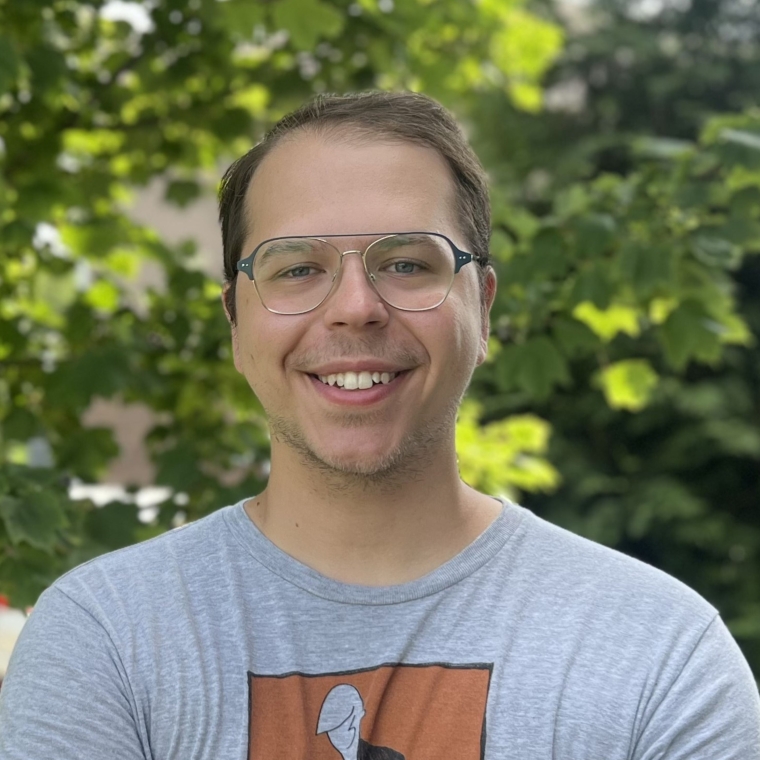
Hometown: Lexington, Kentucky Education Background: B.S. in Mathematics, University of Kentucky
How did you get interested in your field?
I have always been fascinated by maps and cities, but I never considered it as a career choice until I worked for the transit agency in Lexington. Exposure to how transit is considered in city plans, understanding how transit is operated, and seeing firsthand the positive impact it has on a community inspired me to pursue an education that allows me to learn other aspects of urban planning.
What was your background prior to coming to Penn?
After graduating with a degree in mathematics, I worked for a telecommunications company in Lexington, updating GIS records based on completed fieldwork. I was promoted within a year, where I helped migrate from one GIS database to another. Seeking a change of pace and to break into the public sector, I found myself at Lextran (the transit authority of Lexington), where I served as a transit analyst for two years. That experience really opened my eyes to the interesting (and complex) world of city planning.
Why did you choose Penn?
Penn was one of the few schools I found that offered a Smart Cities (or similar) concentration. It is a relatively novel concept in planning, and I was excited to explore how technology, data, and policy are considered in urban environmental issues and digital equity. I was also inspired by the work of PennIUR and their commitment to involving students in projects and research.
What has been your favorite class so far?
My favorite class so far has been Land Use and Environmental Modeling. While I had prior experience with ArcGIS Pro and R, this course expanded my understanding of how the software can be applied to address environmental and sustainability challenges. One assignment that stood out was a hydrological site study, where we conducted a site suitability analysis for a hazardous waste facility and evaluated its potential impact on downstream drinking water supplies. I really appreciated how the course struck a balance between environmental planning and spatial analysis.
What are you learning right now that will help you in the future?
I am currently enrolled in Law of Planning and Urban Development (CPLN 5090), Geospatial Data Science in Python (CPLN 6720), Planning Studio (CPLN 7020), and Technology Deployment to Achieve Net Zero: Decarbonization (ENMG 5400). These courses are helping me refine my skills in developing comprehensive plans, applying Python-based geospatial analysis to address environmental challenges, and understanding how technological innovations can be deployed to target these challenges, such as reducing carbon dioxide emissions in the future.
What do you like best about Philadelphia?
SEPTA has been a game-changer for me. Before coming to Philly, I lived in a car-dependent city. My goal was to move here without a car and rely on public transportation, and so far, I haven’t felt like I've sacrificed convenience (so many routes and transit options!). Additionally, Philadelphia has a rich cultural, historical, and food scene that everyone should experience. I still have so many things to do and see!
What kinds of activities and/or organizations are you involved in?
I am currently a member of the Urban Tech Club, which focuses on exploring how spatial analytics, data, and technology can be integrated into urban spaces. Though most students are either MCP students concentrating in Smart Cities or MUSA students, I encourage anyone to attend an event and get involved!
What are your career ambitions?
After graduation, I hope to apply my knowledge and skills to address environmental and sustainability issues in urban areas, particularly those related to stormwater management. As policies change and new technologies emerge, it is imperative to take the best possible action to mitigate existing problems and prevent further issues from forming and exacerbating them. Using technology and data can help planners be more proactive rather than reactive to issues and disasters, and I want to be at the forefront.