Second Acts in Architecture
With help from members of the Weitzman community, a pair of Philadelphia architectural gems will continue to serve as arts and culture anchors.
With help from members of the Weitzman community, a pair of Philadelphia architectural gems will continue to serve as arts and culture anchors.
When the University of the Arts closed suddenly last year, the painful loss of an arts and culture anchor called into question the fate of a suite of iconic Center City buildings. Two of the most architecturally significant buildings, Hamilton Hall and Furness Hall, are now being reimagined as an arts community by their new owner, Scout, the developer behind the revitalization of the Bok Building in South Philadelphia. A trio of architects with ties to Weitzman and expertise in preservation and tactical urbanism are helping refine the vision for the buildings’ next life.
Hamilton Hall, facing Broad Street, was designed by the architect John Haviland in the 1820s as the Pennsylvania Institution for the Deaf and Dumb. It was later joined with what’s now known as Furness Hall, a dormitory facing Pine Street and 15th designed by Frank Furness, the Philadelphia architect responsible for Fisher Fine Arts Library on Penn’s campus. Scout acquired the pair after a competitive auction in February. It began working almost immediately to open up the buildings to the public with temporary activations, while creating a long-term vision for adaptive reuse.

The courtyard at Furness Hall was opened to the public in the summer of 2025 as Frankie's Summer Club, in a design by ISA. “It’s a really nicely scaled, delightful space, and the tree canopy is amazing,” says ISA Founding Principal and faculty member Brian Phillips. (Photo Bre Furlong for Scout)
Its first activation was Frankie’s Summer Club, a wine bar in a shaded courtyard facing 15th Street. Scout Managing Partner Lindsey Scannapieco tapped ISA, the architecture firm led by Brian Phillips, a lecturer in the Department of Architecture at Weitzman, to design the space. ISA has designed a series of other adaptive reuse projects in Philadelphia, including Cherry Street Pier on the Delaware River and the industrial-to-residential conversion of Huntingdon Mills in Kensington. ISA’s approach to the courtyard at Hamilton and Furness was inspired by an unbuilt design from Louis Kahn, the former Cret Professor of Architecture at Penn. Scout had found plans Kahn designed for an adjacent site, and ISA designed a bar that mimicked the form. The club’s design was finalized and built in a matter of weeks, inviting the public into a space that had been visible but inaccessible for decades—an opening act for the broader reoccupation of the site.
“Nobody had been in there,” Phillips says. “It’s a really nicely scaled, delightful space, and the tree canopy is amazing. I think that was the way to get people in easily.”
At the same time that ISA was working to fit out the Frankie’s Summer Club courtyard, Scout was beginning to develop its vision for the bigger space—a collection of student residences, studios and classrooms that had been used by UArts students and faculty. At the beginning of May, Scout held a design charette in Hamilton Hall, with participants including Professor of Practice in Historic Preservation Jules Dingle, the co-founding partner of architecture firm DIGSAU, and Sam Olshin (MArch’86), a principal at Atkin Olshin Schade.
“We’re really using the building as is. It’s about embracing the found condition and finding people who kind of match that puzzle piece,” Scannapieco says. “This isn’t a full gut renovation. A lot of it is about repairing and reopening and installing signage and other pieces to make it function well.”
DIGSAU has worked on a variety of adaptive reuse projects in Philadelphia, including a master plan for the Globe Dye Works in Frankford and a design for the Forman Arts Initiative’s new Arts Campus, a collaboration with the artist Theaster Gates to transform a block of early 20th-century industrial buildings into a community-centered arts campus. DIGSAU is also currently helping Temple University rework a floor of a former Pennsylvania Academy of Fine Arts building as studio space for recent Temple MFA grads.
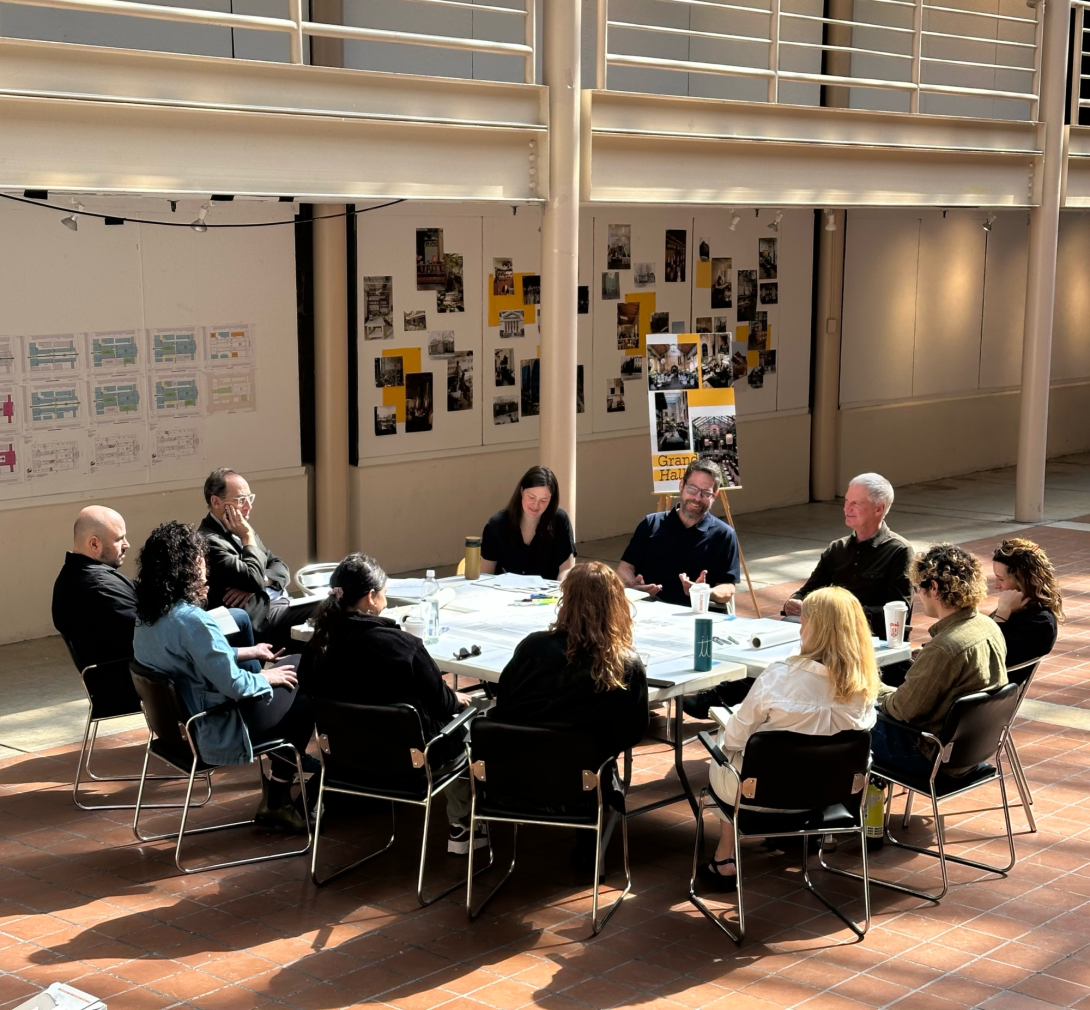
Scout gathered architects including Weitzman's Jules Dingle and alum Sam Olshin (C'82, MArch'86) for a charrette in Hamilton Hall's atrium. (Photo courtesy Scout)
“It started with dreaming, visioning, and then we got right down to what fits,” Dingle says. “It was a really light touch. When we proposed architecture, it was more subtraction than it was about adding something.”
Scannapieco invited Atkin Olshin Schade, meanwhile, to help study the facility conditions. The firm has worked on preservation projects including Penn’s College Hall and Eastern State Penitentiary, and the revitalization of the Met on North Broad Street. It has worked for the last decade with the Academy of Music—just up Broad Street from Hamilton and Furness—helping to repair the roof and facade and restore the balconies. Olshin says while Hamilton and Furness are smaller than the Bok building, they present unique challenges in balancing accessibility and security.
“How do you maintain both the openness and security, a sense of welcoming and a sense of privacy? I think those are the kind of things that came out of the charrette,” Olshin says. “To be able to keep it secure and keep it open at the same time, I think those are challenges [Scannapieco] is just wading through as we speak.”
Frankie’s Summer Club helped to reintroduce the city to Hamilton and Furness, and the charette helped identify design challenges, areas of deferred maintenance, and likely costs. The job now, Scannapieco says, is to turn the building back into an asset for artists and makers. Phillips, Dingle, and Olshin credit Scannapieco for taking a patient approach to the project. Many developers seek quick returns, Phillips says, while others “overinvest” in buildings and drive up the cost of rent or admission to the space. Scout’s approach, by contrast, looks for value in a long-run investment in Philadelphia’s arts community.
It’s a familiar story to Richard Garber, an architect and lecturer who helped develop Weitzman’s new Master of Science in Design with a concentration in Property Development and Design, which recently began accepting applications for Fall 2026 enrollment. “Architects have so much to offer developers, beyond the technical skills and experience they bring,” says Garber, who developed the PDD program with architect Rossana Hu, the Miller Professor and chair of architecture at Weitzman. “The Hamilton and Furness project has all the hallmarks of the kinds of collaboration that makes these projects succeed.”
“We have an arts community that has a lot of need and is very fragile,” Scannapieco says. “Ensuring working artists have a place in the heart of the city is really important for our social, cultural and economic fabric.”

 View Slideshow