
Michael Emmons is the Director of Historic Preservation & Architectural Research at Historic Deerfield in Massachusetts, a museum of history, art, and architecture along a mile-long street laid out in 1671 and still lined with 18th- and 19th-century houses on their original sites. He oversees the conservation and restoration of 55 historic buildings there, in addition to performing architectural documentation and organizing symposia about architectural history and the trades.
For 6 years, he served as the Assistant Director and Senior Architectural Historian at the Center for Historic Architecture & Design (CHAD) at the University of Delaware, a research unit that engages in historic preservation projects throughout the Mid-Atlantic and beyond. The Center specializes in nomination packages for the National Register of Historic Places/National Historic Landmark programs, architectural documentation through measured drawings and photography, as well as cultural resource surveys and other historic preservation planning and consultation. He also taught in the Historic Preservation program at UD's Biden School of Public Policy & Administration, including one of the program’s core courses, Theory & Practice.
A historian by trade, Emmons earned a Bachelor's degree in History from Bowling Green State University and a Master's degree in History from the University of Connecticut, specializing in nineteenth-century U.S. cultural history. He later completed a Master's degree in Historic Preservation at the University of Delaware, where he is currently a PhD candidate in Preservation Studies.
Emmons' dissertation, "Patterns in Early American Graffiti," is an interdisciplinary examination of historical graffiti in the northeastern United States between 1700-1870, identifying the most common patterns in the age, content, and location of historical graffiti, while also evaluating its value and significance for architectural studies and historical interpretation. His research is the first attempt at evaluating broader trends in historical inscription practices in the U.S., and the social and cultural reasons for these trends.
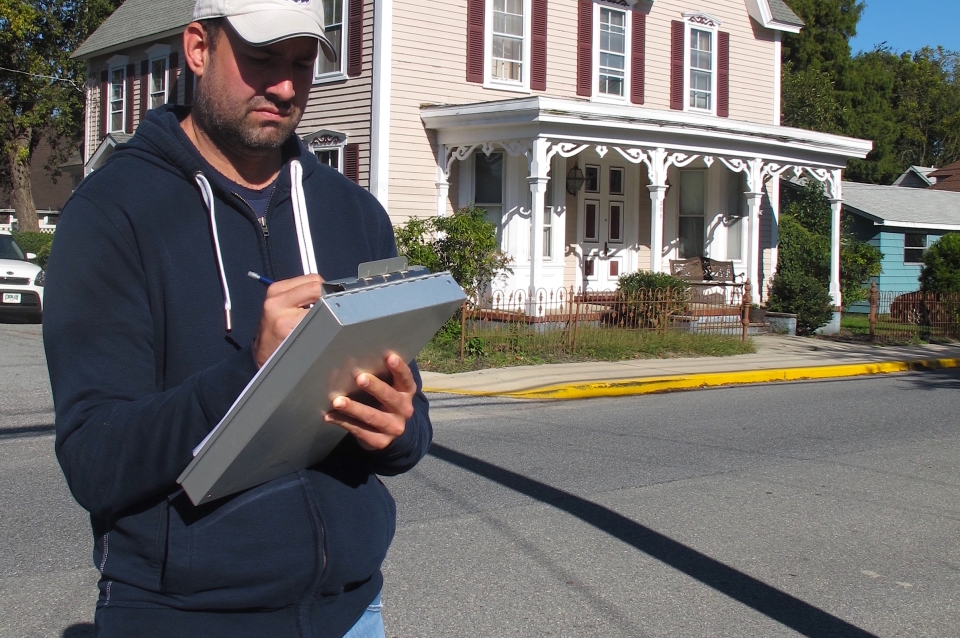
Performing a cultural resource survey in a Victorian era historic district in Sussex County, Delaware.
 View Slideshow