Leslie Richards on Penn’s Ambitious New Transportation Initiative
The former CEO of PennDOT and SEPTA is working to break down silos and overcome the barriers to innovation.
The former CEO of PennDOT and SEPTA is working to break down silos and overcome the barriers to innovation.
In October, the Department of City and Regional Planning and the Penn Institute for Urban Research joined forces to convene transportation leaders from across the US for the launch of the Transportation Initiative at Penn. TRIP is the brainchild of Leslie Richards, former CEO of PennDOT and SEPTA and now professor of practice at Weitzman, and Megan Ryerson, UPS Foundation Professor and chair of city and regional planning. The initiative aims to connect groundbreaking academic research with the complex realities of modern transportation systems, bringing innovative transportation ideas from the lab to the streets.
What were some of the highlights of the launch?
Having colleagues from across the country show up in big numbers—not just from the public sector, but also from the private sector—that felt really good. There are all these gaps that we’re trying to fill, and one of those gaps is that senior executives across modes don’t get the opportunity to talk to each other in a productive and meaningful way. The roads and the bridges people go to their meetings, the transit people go to their meetings, the airport people go to their meetings, the port people go to their meetings, the turnpike people have theirs, and so on.
The same is true of the private sector. When you look at an engineering firm, they have different market sectors: they have their aviation team, their roads team, their transit team. Even having those representatives in the same room is unusual. So we’re breaking down all these silos that have existed in this industry.
What opportunities does that present?
Getting people out of the traditional marketing meetings, the project information meetings, the procurement or upcoming requests for proposals—it allows you to talk about a variety of things in a less formal environment. Your guard is down and you can just say, “I'm having a hard time with this.” People can talk about the latest research and technology, what keeps them up at night, and success stories. You can just feel the trust in the room.
When you combine the public sector and the private sector, there’s also an opportunity for people to understand what it’s like to be in charge of the day-to-day operations of a large agency. I feel like I saw some of our private partners think, “Oh, that’s why it's not so simple.” So it also allows us to better understand each other and better understand the challenges in the public sector and how the private sector can help out.
And then there’s the policy brief that we’ll publish based on the event. In academia, this is a typical thing to do, but it doesn’t get done in the industry in the same way.
What are some of the challenges that people came forward with?
The rigidity of the procurement system, and getting the buy-in to take some risks. We talked some of the best ideas are just these scrappy pilots that we try to push forward. We had a fireside chat by Leigh Palmer [Vice President of Technology, Delivery and Operations] from Google Public Sector, who talked about an idea that literally started by taping phones to vehicles so that they could receive pixelated images of the surroundings around the vehicle. It’s that mentality: Go out and do it! But it’s tough. The agency leaders are very much aware that their agencies are a bit risk-averse and they’re very much aware of what it takes to move something forward in a hundred-year-old agency that maybe doesn’t have the latest technology.
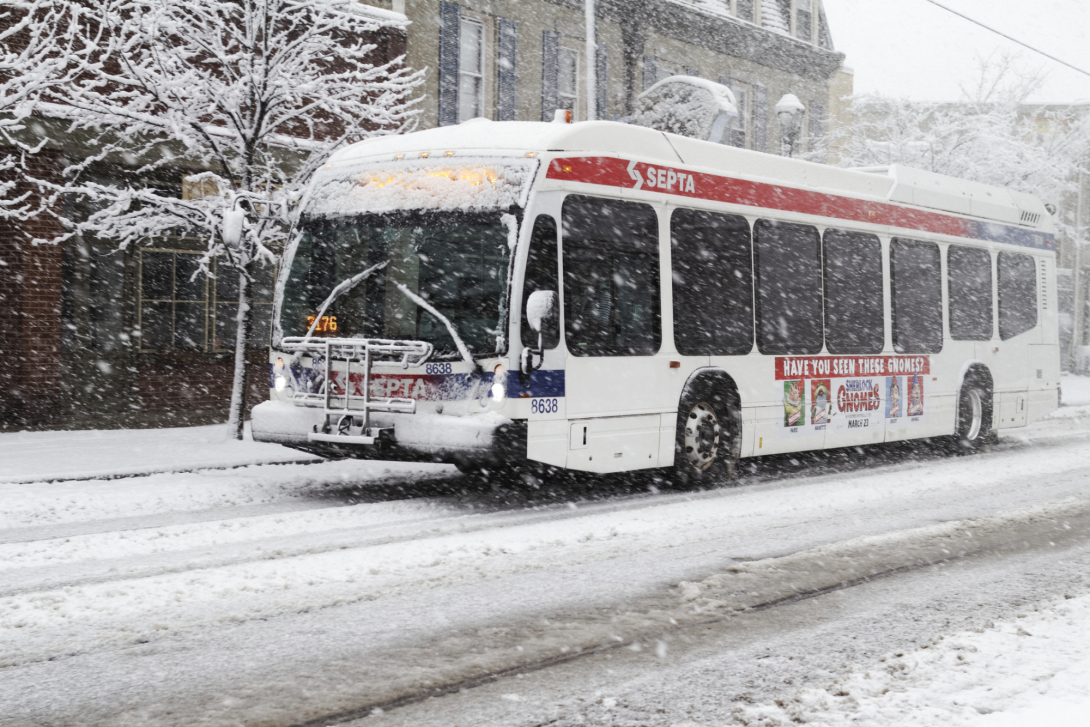
"People think these large agencies have not thought of new ideas in decades, but the exact opposite is true," says Richards. "No day is exactly the same. They are continuously adjusting to new parameters: weather, conditions, or deferred maintenance."
What kinds of collaborations do you envision?
I think the challenge is going to be picking a few. One of the highlights of the launch was when we had two founders of startups—Jawnt and SahayAI—present what they’re working on. One of the founders of Jawnt is one of my former students, and he presented on the problem they wanted to solve—how they took this very difficult concept of commuter benefits and were able to simplify it for the agencies and for the employers, working with their HR and benefits offices, to make it seamless. I know for certain it would never have happened here in the Philadelphia region without Jawnt. We needed somebody who was able to connect all of those dots for us, and we did not have the capacity at the time at SEPTA. And the employers, no matter how big or small, they also didn’t have the capacity. Jawnt saw the need, came in, and now they have the Commonwealth of Pennsylvania and other cities across the country as clients.
And then there’s the work being done at SahayAI for preventative maintenance in transit and transportation. They have cameras connected to a snow plow or a construction vehicle or a revenue train that look at the environment, signal positions, track condition asphalt quality, guide rail placements. It helps with the data collection and the analysis.
That’s not something that the agency leaders get to hear a lot—how these businesses begin and how they’re being built—so it was exciting for them to hear.
You’re interested in connecting academia and industry, but I imagine there may be a trust issue there. As in, some academics might feel like practitioners aren’t ambitious enough, while practitioners might think academics are divorced from the reality of day-to-day operations.
Both of those are true and I see TRIP bridging that gap. We need researchers for the particular issues that we’re going to try to solve. We need researchers who have an understanding that there are restrictions in the public sector that cannot be changed in the short term—whether they’re financial restrictions, procurement, supply chain, or outdated computer systems.
And we also need agencies to be forward-thinking and trust the researchers to come up with solutions— solutions that aren’t bound by the restrictions that the agencies know exist. Sometimes that’s where the answer is. Someone who’s been working at an agency for 20+ years and has always turned right, because you couldn’t go to the left, could realize, “Maybe we can go to the left here.”
There definitely has to be a willingness to step out of you comfort zone. Those are the types of conversations that are taking place.
If you’re running an agency, I imagine there can never be enough resources because of all of the possible disruptions to service. Infrastructure is always aging, there are shifting ridership patterns, climate change is causing more extreme weather events.
That is the reason why innovation is so important. People think these large agencies have not thought of new ideas in decades, but the exact opposite is true. No day is exactly the same. They are continuously adjusting to new parameters: weather, conditions, or deferred maintenance. These agencies are very good at it, but that’s not the story that gets told often. In some ways they’re not as risk averse as they think, and that is why it’s important for us to be open to discussions where we may not always have the answer. You come up with better solutions when you have a variety of perspectives as part of the conversation.

 Expand Image