
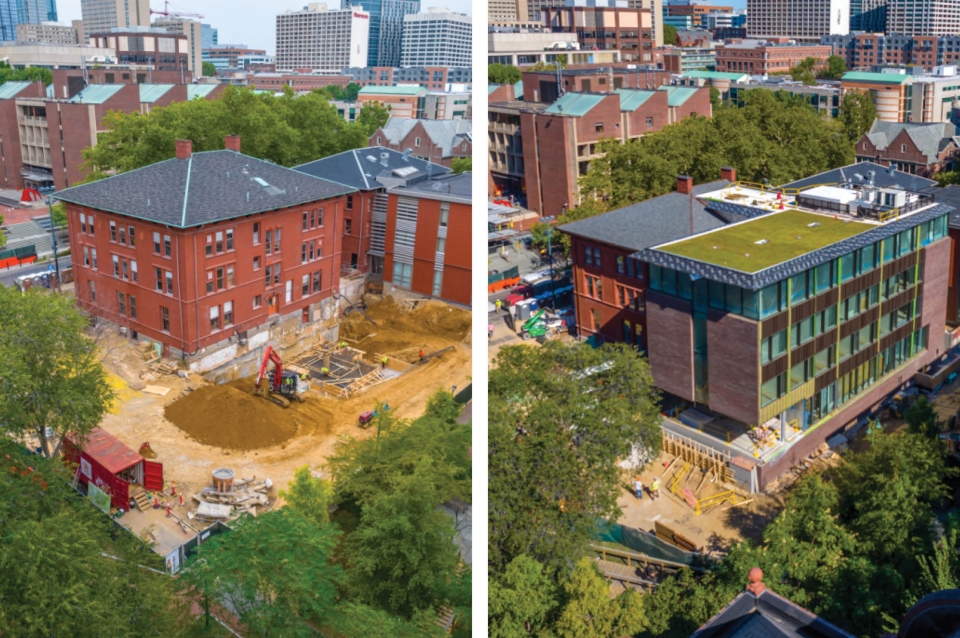
 View Slideshow

As the Weitzman School of Design prepares to open its first new building in more than 50 years—an interdisciplinary hub for research and teaching in the historic heart of Penn’s campus—Weitzman News gathered members of the design and construction teams for a series of conversations about the making of Stuart Weitzman Hall. This conversation included Kevin Burns, project executive, Target Building; Adam Loughry, associate [architect], KieranTimberlake; and Karl Wellman, senior executive director of operations and planning, design and construction at Weitzman. The building’s history and adaptive reuse will be the subject of an exhibition in early 2026.
What are the main chapters of a capital project like this?
Adam Loughry: Sometimes the initial phase is called a concept design, sometimes it begins with a feasibility study. On the Weitzman Hall project, we undertook a feasibility study in the fall of 2021: a six-week sprint to understand the needs of the school, what needs weren’t being met, the proposed environment where this intervention’s happening, and then to test fit the needs against the spatial constraints of the building site. The feasibility study is trying to shake out what the carrying capacity of the site is, what the program needs are, and how to map those on to the specific site.
One of the core takeaways was this is an incredible opportunity to revitalize an existing historic structure on campus to serve as a model for renovation across campus and academic settings around the country. And then also leverage this location. This is the historic precinct of Penn’s campus—we’re really in the heart of it, and coincidentally, that’s the heart of the Weitzman School as well, with Meyerson and Fisher Fine Arts directly across 34th Street.
Once the principal funding for the project was secured, we started understanding deeply what the school’s needs were and translating that into a set of documents that ultimately could be bid and built from. Schematic Design was the first of three design phases that we undertook for the project, the second and third being Design Development, and then Construction Documentation respectively.
Schematic design is really focused on verifying the program. We conduct a number of stakeholder engagement sessions and workshops. We meet with faculty and staff to learn what needs aren’t being met. And then we roll up our sleeves and start getting after the design, bringing on board a large consultant team of subject matter experts in the design profession: structural engineers, civil engineers, campus utility engineers, mechanical, electrical, plumbing, engineers, etc. At the end of schematic design, we produce preliminary drawings to capture the scope of the project such that a cost estimate can be produced. We check back in at each of the design phases on the cost of the work to make sure that we’re still tracking in the right direction, and usually there are some adjustments that need to be made.
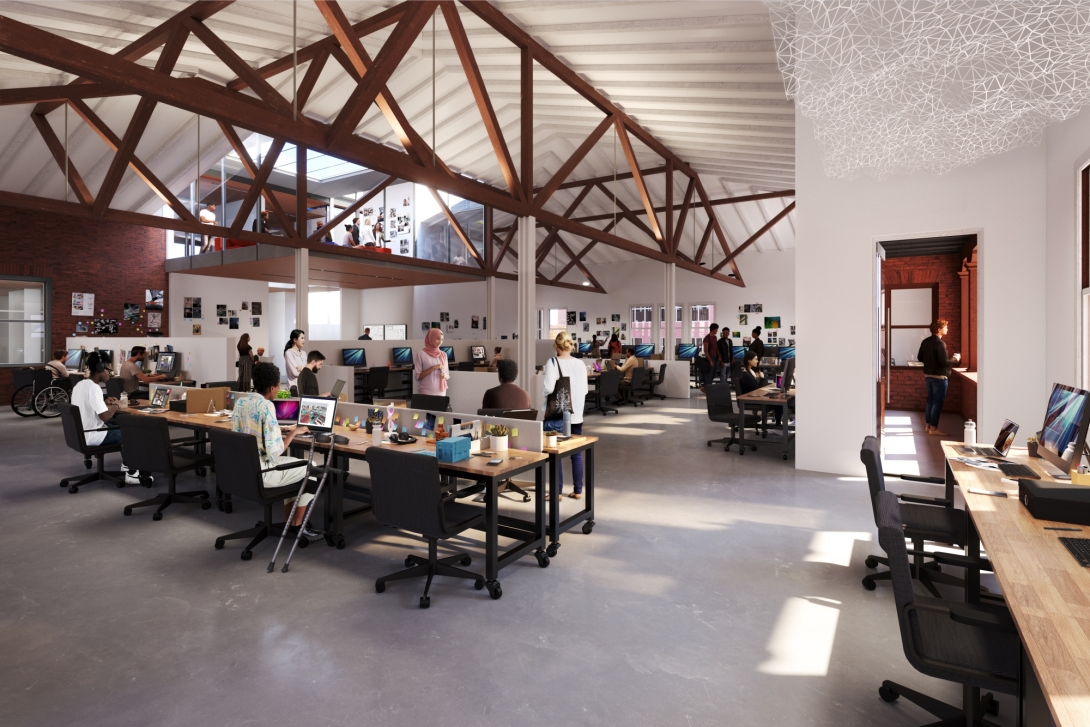
"This [was] an incredible opportunity to revitalize an existing historic structure on campus to serve as a model for renovation across campus and academic settings around the country," says KieranTimberlake's Adam Loughry. An early rendering of the flex studio space on the upper floor of the historic building was completed as part of the feasibility study. (KieranTimberlake)
Once budget alignment is confirmed, we enter the design development phase, focusing on definition of the systems that make up the building, from the façade material palette and how we keep the weather out to coordinating how all the systems work together to meet the project goals. And then we check back in again on the cost of that work through an updated cost estimate. We were fortunate to have the Target Construction team join us in early schematic design. They were able to provide feedback at each of these phases on the cost based on the various market forces at work, like those at the end of COVID.
The last design phase is focused on generating the detailed drawings and specifications that will be used by a number of contractors to bid on each of the scope packages for the project. Ultimately, the builders use the documents from that bid phase to deliver the built project.
There are also regulatory and design review processes. For Weitzman Hall, this included many different steps of review and approval specific to Penn leadership, the Weitzman School, and as is typical for institutional projects, there is a parallel peer review process. At Penn, that process is called the Design Review Committee. It is led by the Office of the University Architect and Dean Steiner, acting as the chair. They lead a committee of faculty members and design professionals, architects, and preservationists that are outside the institution who critique our work. That’s helpful in terms of editing and adding more clarity to the project. Then there is the regulatory permitting process, including historic review, zoning, stormwater and utility review, building and construction permitting, etc..
Karl Wellman: I’d like to think that the Weitzman School is the perfect client in this type of project because we’re working in those fields. We held a number of meetings with the faculty staff, alumni—including alumni who are working for KieranTimberlake, PORT Urbanism and Landscape Architecture, and Preservation Design Partnership. That was extremely beneficial to determining what the needs were, not only overall for the school, but for the individual programs. This is our first new build design in 58 years, so we had to get it right. It was important to provide for the future of those programs [in architecture, landscape architecture, city and regional planning, historic preservation, and fine arts]. It’s also the first opportunity for our school to have all five academic disciplines have programming in the same building.
How does a construction management team deliver a 40,000 square-foot building in 15 months?
Kevin Burns: Our job is to build the job on paper first. You go through a shop drawing process, you go through the request for information process, and get the thing coordinated on paper in hopes of prefabricating items off site.
The success of a project like this depends on a collaborative team approach from the very beginning: understanding lead times of main equipment like electrical switch gears, air handling units—stuff that takes a significant amount of time to procure—and then getting them on site exactly when you need them. Every day something needs to happen. If something gets pushed back, something else needs to get moved up in its place.
We have around 45 subcontractors and vendors on the project directly subcontracted through Target Building. Each one of them has multiple suppliers, so I would say that are between 135-150 total suppliers on the project. So there’s a constant give-and-take.
Karl Wellman: I think it’s important to have people invested in the project, from the design team to the trades people. When you see the construction workers taking their lunch across from the job site, looking at the building—I know they’re going to drive by later, they’re going to show their children, and say, “I built that building.” I think they have a great amount of pride in their work.
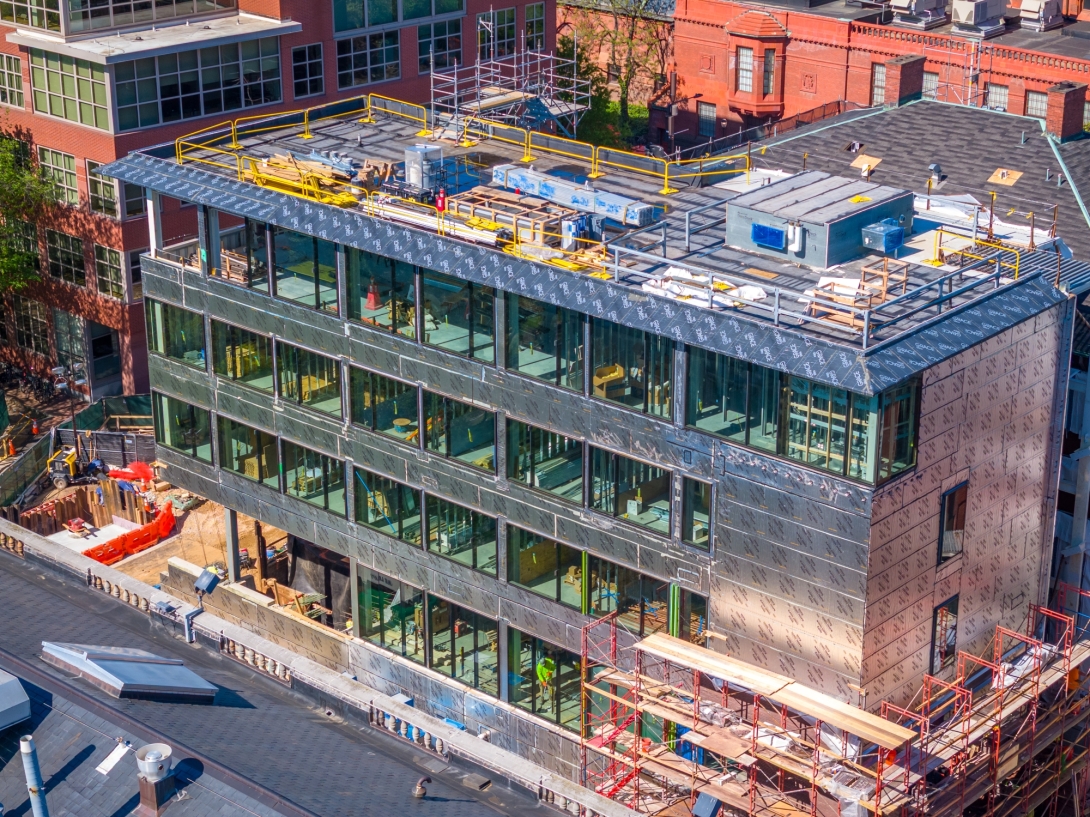
"We worked through a difficult curtain wall submittal process on this job," says Target Building's Kevin Burns. (Photo Target Building)
What was the most important decision that you had to make for this project?
Kevin Burns: We worked through a difficult curtain wall submittal process on this job where we needed to ask for KieranTimberlake’s help to break down the approvals into individual components to hit critical release dates to maintain schedule. It started with color approval along with the final profile shape as we were satisfied with those individual components. We weren’t satisfied with some of the detailing at the time and didn’t have a perfect set of shop drawings, but we were able to release to fabrication stock extrusions/mullions to maintain schedule and allow the shop drawing coordination process more time. The next focus for the team was glass sizes, while we continued with the final detailing process. By finalizing those elevations, we were then able to place the glass order in time for when product was needed on site. Those intermediate releases along the way, while the full coordination set of drawings were being finalized enabled the material to be delivered on time and get the building closed in. It was a calculated risk that we needed to make, and I think ultimately paid off. So, my hardest decisions are making calculated risks on certain long-lead materials.
Adam Loughry: I wouldn’t characterize it as the most important decision, but at the beginning of the design process, the addition was a mass timber structure, which was very exciting. This would have been on the heels of the completion of Amy Gutmann Hall, making Weitzman Hall just the second mass timber building in Philadelphia, both on Penn’s campus. It was a great story because of the timber structure in the existing, historic [Morgan] building. Ultimately, for cost reasons, the decision was made to use a steel structure instead. But as a result, we have more flexible floor plates that are wide open; there are no internal columns. In the addition, much like the existing building, the school could reorganize the entire building on Day Two with complete flexibility, if they wanted or needed to reprogram it or adjust for the evolving needs of the various programs. I think that was a win for the project, but at the time, it felt like a loss.
Karl Wellman: Mine was the value engineering aspect of this project. It was being able to go through the process knowing what we could sacrifice without crossing a line where the programming and future proofing of the project was being affected. It’s that fine line between having a project and doing good and not being able to service the needs of your people. We were able to get to that point where the project was within budget, and we were delivering what we were asked for by our students and faculty.
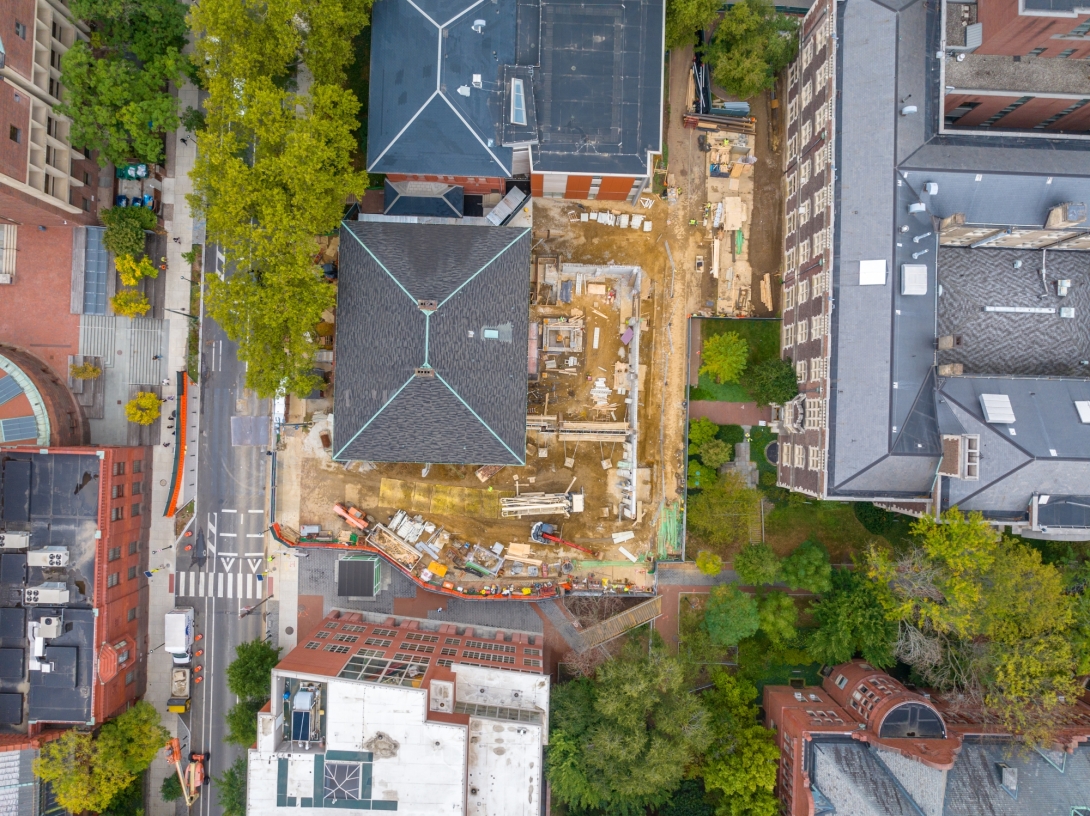
"The challenge that we faced daily is that there’s only one entrance to deliver anything to this construction site." 34th Street is seen at left, the Towne Building at right. (Photo Target Building)
What are some of the logistical challenges in a project like this?
Kevin Burns: Building in a city environment where your space constraints are tight requires an extreme level of coordination. At this point, our original site logistics plans probably have had 35 revisions to them from the original plan. We have to be nimble to be successful. You cannot assume that this is the way we’ve always done it, this is the way it’s going to work. Challenges are going to get thrown our way. At the crosswalk on 34th Street, for example, we thought we had the greatest plan in the world, but then students wouldn’t follow all of the signage and walk where they were supposed to walk. We needed to rethink and put a crosswalk guard out there.
Karl Wellman: You’re working 34th Street, the main thoroughfare for the city of Philadelphia leading to the Hospital of the University of Pennsylvania. That has to remain open. Even shutting a lane down is extremely difficult to bring in cranes or equipment or material.
Can you talk about a challenge that got thrown your way during construction?
Kevin Burns: We really, really worked hard with Adam and his team at KT to get structural steel because a lot of this steel is visible when we’re done. We were meeting with detailers every Thursday for one to three hours—detailers up in Canada. The process itself didn’t necessarily yield exactly when we wanted the steel to be there, so we were probably about three and a half to four weeks later starting the steel than we would’ve liked. To keep the project moving forward, there were things that were supposed to occur later in the construction schedule—like under slab, rough in with plumbing, rough in with electrical, under a basement slab on grade—so that when the steel was completed, we weren’t the same three to four weeks behind.
The challenge that we faced daily is that there’s only one entrance to deliver anything to this construction site. So you’re crossing over areas that you’re actually working in—we’re constantly passing from our left hand to our right hand around the building. And it’s something that’s really hard to put on paper when you’re doing cost estimates and plans. It’s really a testament to our superintendent and all of the tradespeople working together. Our delivery schedule per day is down to the hour. The foremen have a group text that they share and they say, “I’m pouring concrete at 11,” and other people shift what they’re doing.
How does the role of the architect shift once construction has started?
Adam Loughry: Our role changes dramatically from interfacing with user groups and translating feedback from the school and larger Penn stakeholder groups during design to advising the team on the progress of the construction work and its alignment with the design intent and stakeholder requirements in construction. We provide context and history, and if the documents are not clear or if something isn’t resolving in the way that everyone had hoped, we help determine the best path forward. And there’s always a give-and-take. Unforeseen challenges always arise during construction. I mean, this building has never been built before; it’s a snowflake, one of a kind. Yes, to make a building, it’s the same basic ingredients, but you’re also making something wholly new, solving similar but different problems, every time. It takes everybody’s willingness to seek solutions and not get stuck. And it’s amazing when it all comes together!

