Stuart Weitzman Hall

An incubator for a more beautiful, equitable, and sustainable future
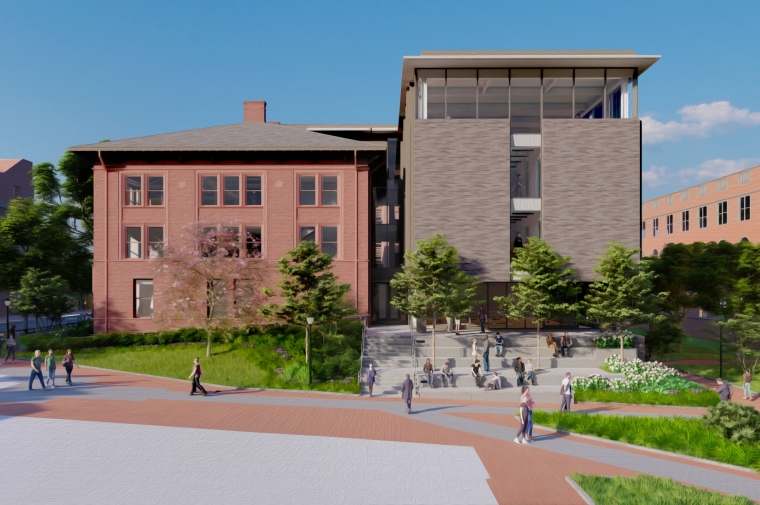
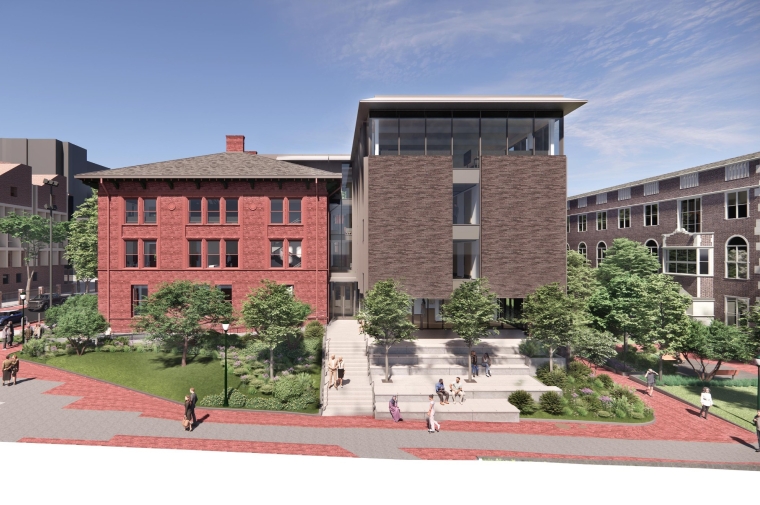
Brick building next to glass and brown brick addition
The Weitzman School's first major capital project in nearly 60 years is an investment in cultural heritage as well as sustainability. (Halkin Mason Photography)
Close
The Weitzman School's first major capital project in nearly 60 years is an investment in cultural heritage as well as sustainability. (Halkin Mason Photography)
Photo: Eric Sucar for University Communications
Photo: Kait Privitera
Photo: Eric Sucar for University Communications
Photo: Kait Privitera

“Here, students and faculty from across the Weitzman School will work to confront the most pressing challenges in the built world and culture at large,” says Dean and Paley Professor Fritz Steiner.

Under one roof, artists will push the boundaries of creative expression, designers and planners devise solutions to neighborhood challenges, policy experts develop the means to accelerate the clean energy transition, and community members take part in year-round exhibitions and lectures.

Celebrating Stuart Weitzman Hall

On February 5, the Weitzman School welcomed guests from across campus and beyond for a ribbon cutting and open house at Stuart Weitzman Hall.

View Flickr Album


Dean Steiner, Stuart Weitzman, Dr Jameson cut a ribbon for the building

Explore the Building, Floor by Floor

On February 5, the Weitzman community was invited to explore all five floors of the new building at an Open House celebration.

Design & Sustainability

As headquarters for the Department of Fine Arts, Weitzman Hall features:

  • Purpose-built art and design studios
  • Individual MFA student studios
  • Fully-equipped maker spaces
  • Terry Adkins Sculpture Studio

As an interdisciplinary hub, the building's program also includes:

  • Light-filled smart classrooms and meeting rooms
  • Research facilities for the Kleinman Center for Energy Policy, Preservation Research Collaborative at Penn, and University Art Collection
  • Dedicated exhibition spaces including the Gordon Gallery
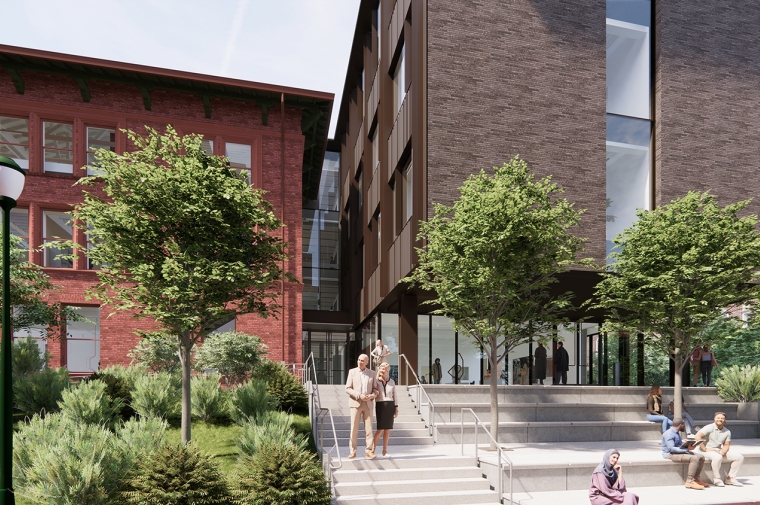
  • The Linhart Family Patio for temporary, outdoor exhibitions

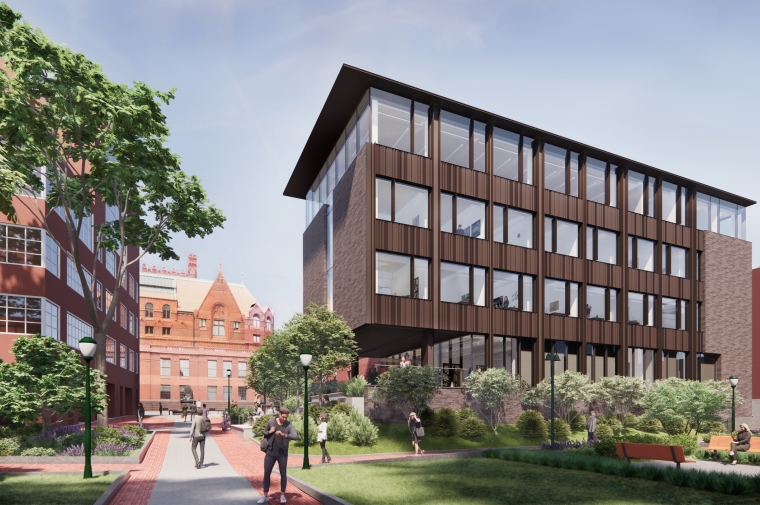
Conceived as a model of architectural renewal, the future Weitzman Hall retains the existing building’s envelope and architecturally significant elements, with a completely reimagined interior, to reduce embodied carbon as well as future carbon emissions.

“Preservation is the original form of sustainability,” said Frank Matero, the late Gonick Family Professor and past chair of historic preservation at Weitzman.

Weitzman Hall is targeting LEED Platinum Certification.

Team

The design team consists of graduates and faculty of the school who are at the forefront of their profession.

Architect: KieranTimberlake
Stephen Kieran (MArch’76) and James Timberlake (MArch’77), founding principals

Preservation Consultants: Preservation Design Partnership
Dominique Hawkins (C'92, MArch'92, MSHP'92), principal

Landscape Architect: PORT Urbanism
Christopher Marcinkoski, principal and associate professor in the Department of Landscape Architecture

Cross-Disciplinary Connections

Weitzman Hall brings together students and faculty from across the School and the University.

A History of Opportunity and Exploration

From its origins, the building at 205 South 34 Street has been a beacon of opportunity. It began its life as the Foulke and Long Institute, a prototype orphanage for girls that provided not only shelter but education, which opened in 1893, just three years after Penn’s architecture program was formally established. The three-story, Italianate palazzo-like building was designed by renowned Philadelphia firm Cope & Stewardson, which also designed Penn’s iconic Quad.

Penn acquired the property in 1899, and for nearly five decades it housed a lab for the Department of Physics. In 1939, it became the site of one of the largest electrostatic generators for atomic research in the United States, until the building was re-purposed as a School of Nursing facility in 1955.

The building was named the Morgan Building for Randall Morgan, an 1873 alum and Penn trustee, in the mid-1950s. From the 1970s, the building housed artist studios for MFA students, classrooms, offices, and a printmaking studio for the Department of Fine Arts. In 2022, it was renamed for Stuart Weitzman (Wharton Class of 1963) in recognition of his extraordinary support for Penn and the Weitzman School.

Fast Facts
  • Nearly 40,000 square feet
  • 2,700 square feet of dedicated exhibition space
  • Construction Began: March 2024
  • Completion: September 2025
  • LEED Platinum Certification (Expected)
Section showing crit spaces, gallery, studios throughout building

Acknowledgements

The Weitzman School of Design gratefully recognizes Stuart Weitzman, W’63, whose extraordinary generosity made Weitzman Hall possible and strengthened the School’s mission to shape a more beautiful, healthy, and sustainable world through art and design.

The School also extends its sincere appreciation to the many donors whose support helped bring Weitzman Hall to life and whose commitment continues to advance excellence in art and design education and research. These donors are recognized on named spaces throughout the building, as of February 5, 2026:

Anonymous; William T. Bickford, MArch’02; Jestena C. Boughton, CW’68, MLA’79; Kin Hung “William” Chan, MArch’03 and Kin Wai “Kevin” Chan, ENG’97, W’97; Kathy Choi (Lee), W’91, John Choi, W’94 and Caleb Choi, C’26; Richard J. Davies, C'83 and Jayne C. Davies; Mireya E. Kam, C’93, W’93 and Maximilian E. Weise, ENG’93, W’93, WG’98; Scott Kleinman, C’94, W’94 and Wendy Kleinman; Marc Kushner, C’99; Philip Kwan, W’04 and Sophie Tao; Richard Linhart, W’83 and Leora Mogilner, MD; Michael G. Linn, C’99 and Cheryl Frank; Michael G. Manasse, W’90, L’96 and Elizabeth F. Manasse; Danielle Mandelbaum Anderman, C’94; Marc Margulies, FAIA, C'76, MArch’79 and Anne Margulies; Matthew H. Nord, W’01 and Erika Weinberg; Orville Gordon Browne Foundation Estate of Joanne M. Pizzo, MArch’86; Kevin S. Penn, W’83 and Erica J. Penn; Ligia Ravé in memory of David Slovic, MArch’66; Richard M. Rosan, MArch’67; Amrita Sen, W’92 and Ravi Ahuja, W’92, WG’97; Frederick "Fritz" Steiner, MRP’77, MA’86, PhD’86 and Anna O. Steiner; and Peggy Wachs, CW’59, MCP’75, L’86.

Beyond the named spaces, the School is grateful to the University of Pennsylvania Office of the Curator for their continued partnership and for bringing the Penn Art Collection’s Prints on Paper to Stuart Weitzman Hall. In addition, Amy Gutmann, Penn President Emerita and Christopher H. Browne Distinguished Professor of Political Science, was an invaluable early champion.